What Is Hardwood Furniture?
In the realm of high-quality furniture manufacturing, hardwood is not merely a material—it’s a benchmark for structural integrity, design fidelity, and longevity. Understanding what constitutes hardwood furniture involves more than recognizing the species used. It requires a deeper dive into the anatomical, mechanical, and functional properties of the wood, as well as its behavior under craftsmanship and end-user conditions.
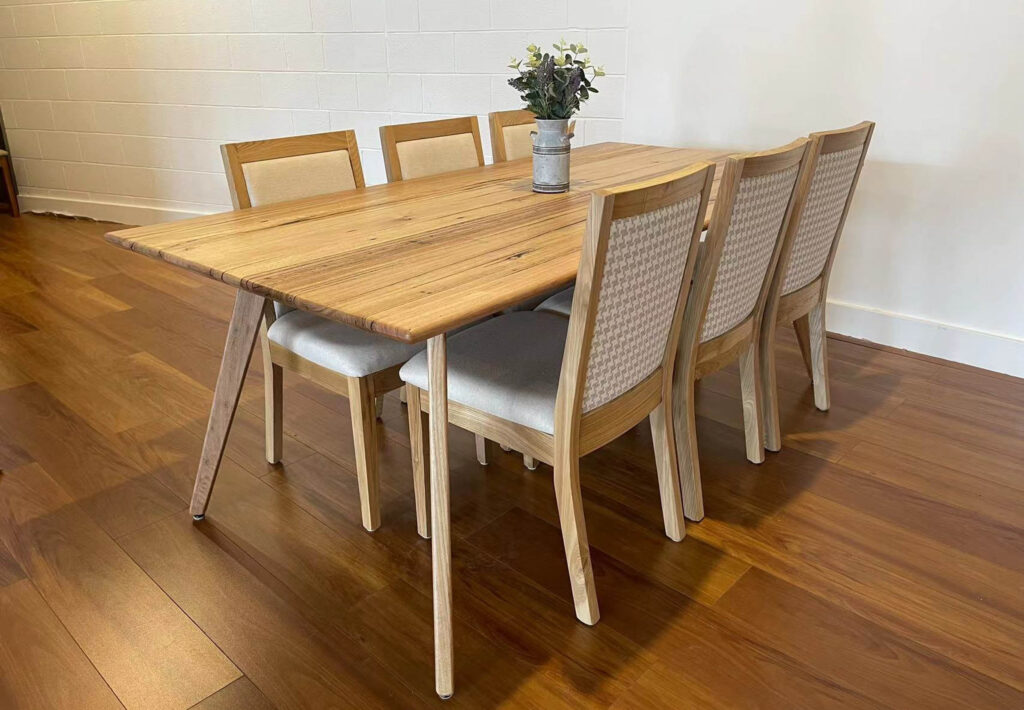
Defining Hardwood
Hardwood refers to timber sourced from angiosperm trees—broadleaf, flowering species such as Quercus (oak), Juglans (walnut), Acer (maple), Swietenia (mahogany), and Tectona grandis (teak). These species exhibit vessel elements in their xylem structure, distinguishing them anatomically from gymnosperms (softwoods).
From a physical standpoint, hardwoods generally have:
- Higher density (typically > 0.60 g/cm³)
- Greater dimensional stability
- Superior wear resistance and load-bearing performance
These properties make hardwood ideal for applications requiring high structural strength and long-term durability.
Why Hardwood is Preferred in Fine Furniture?
Mechanical Strength and Stability
Species like white oak and hard maple exhibit high modulus of rupture and Janka hardness ratings, providing strong resistance to compressive and tensile forces. This makes them suitable for load-bearing elements in furniture such as bed frames, chair legs, and cabinet structures.
Surface Finishing and Aesthetic Fidelity
Hardwood accepts stains and finishes more uniformly due to its finer grain structure. Walnut, for example, delivers deep contrast and texture without extensive surface treatment, which makes it highly valued in luxury-grade furniture.
Joinery and Workability
Skilled craftsmen often prefer hardwoods because they maintain dimensional tolerance during precision machining, mortise-and-tenon joinery, and dovetailing. Teak and mahogany, in particular, exhibit excellent carving characteristics and resistance to splintering.
Solid Hardwood vs. Composite Constructions
Refers to furniture built from milled, kiln-dried planks of a single hardwood species. These pieces are more durable, can be refinished multiple times, and exhibit consistent aging behavior. However, they are susceptible to humidity-induced expansion/contraction and require proper design compensation (e.g., floating panels, expansion gaps).
Often involves hardwood veneer laminated over MDF or plywood substrates. While this improves dimensional stability and reduces cost, it limits the furniture’s lifespan and restricts refinishing capabilities. It is widely used in cost-sensitive commercial applications where appearance is prioritized over structural longevity.
Material Behavior in Service Conditions
Hardwood furniture must be designed with wood movement in mind. For example:
- Tangential shrinkage in oak can be up to 10%, requiring floating joinery in wide panels.
- Differential humidity can lead to cupping or warping if grain orientation is ignored.
- In high-load scenarios, fatigue performance of hardwood is superior to softwood or engineered panels.
A well-designed hardwood piece is not just about aesthetics—it incorporates material science, structural mechanics, and environmental response into the design process.
Environmental and Regulatory Considerations
Premium hardwood furniture often uses FSC-certified or PEFC-certified timber, ensuring sustainability and legal compliance. Many high-end manufacturers also perform moisture content regulation via kiln drying (typically 6–8% for indoor use) to minimize warping risk post-manufacture.
Conclusion
Hardwood furniture represents a fusion of nature’s best engineering with human craftsmanship. It is not a marketing label—it’s a materials category backed by measurable properties, performance consistency, and aesthetic permanence. For consumers and professionals alike, understanding hardwood means recognizing its role not just as furniture, but as enduring architecture within our living spaces.